
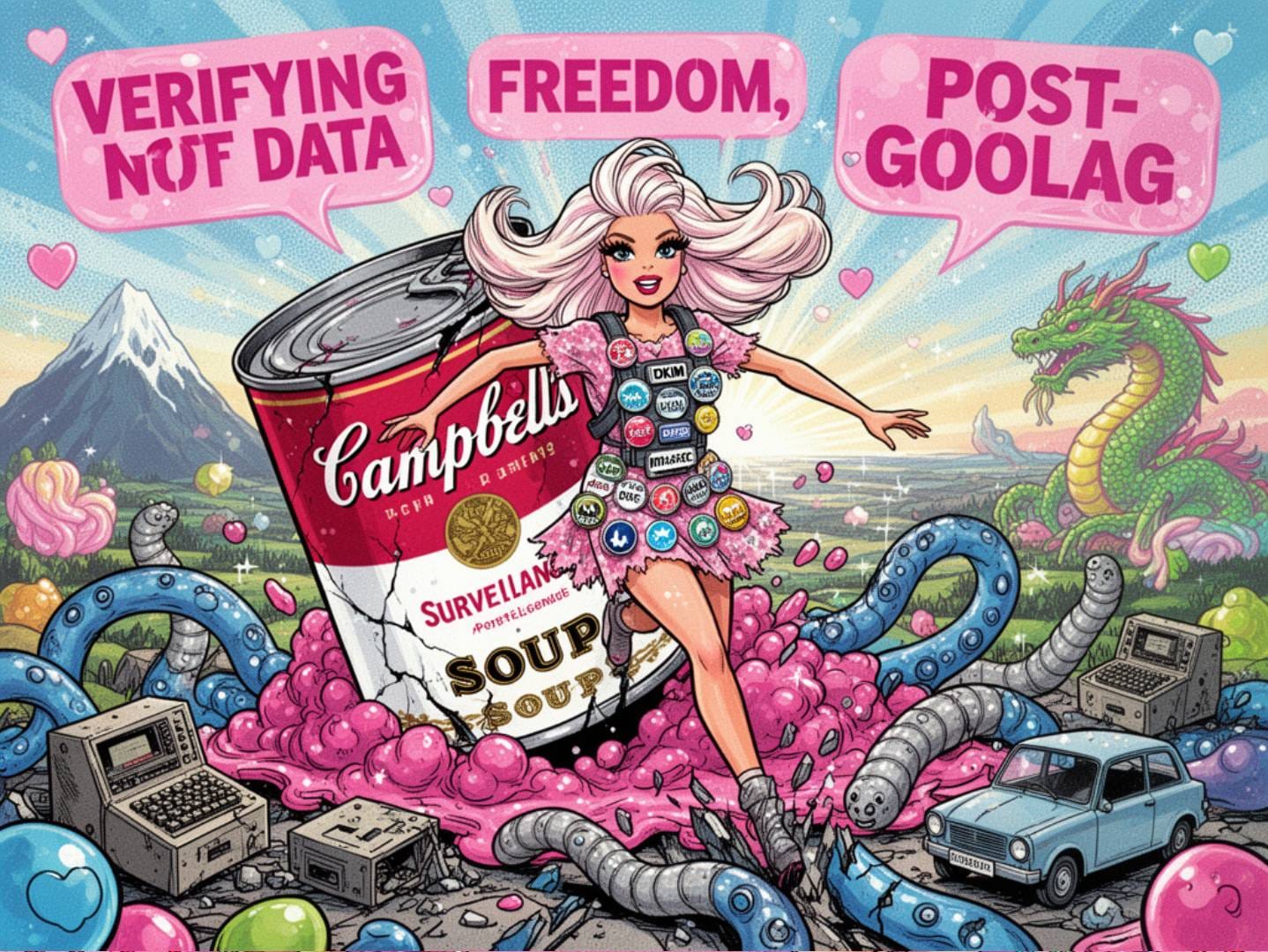
We were promised the future. Instead we got G*ail — the friendliest, most colorful, most “free” surveillance node ever built. What began as a quirky webmail service with 1GB of storage in 2004 has metastasized into the central nervous system of surveillance capitalism.
Every attachment, every calendar invite, every scanned receipt, every whispered keyword is harvested, profiled, sold, and fed into the behavioral futures markets that now run the planet. Goggle (Goolag) doesn’t sell your email. It sells the shadow profile it builds from your email. That is the difference between 1990s spam and 2026 total information awareness.
And yet… people still use email. They still treat it as a serious channel of communication. In the year 2026 this is the equivalent of driving a Trabant while posting “the revolution will be televised” on a Soviet BBS. It is SO 1990. It is digital Goolag cosplay.
But the prisoners are starting to notice the bars.
This long article maps the entire decaying ecosystem — from the corporate honey traps (G*ail, Out*ook, Ya*oo) through the “privacy” providers (Tutanota, Proton Mail, Mailfence, Skiff, CTemplar, Posteo) down to the only path that still offers real autonomy: owning your own domain and running your own secure mail infrastructure. We will dissect every technical layer that actually matters: domain registration security, SPF, DKIM, DMARC, PGP/OpenPGP, S/MIME, DNSSEC, certificate pinning, zero-knowledge architecture, metadata leakage, and the brutal economics of running mail in an age of aggressive spam filtering and state-level adversaries.

Part 1: The Corporate Providers – Sweet Jelly-Colored Parasites
G*ail remains the default. It is frictionless, beautiful, and completely compromised. Every message is scanned in real time. Goggle’s own documentation admits it uses email content “to improve products” and to personalize ads. Even if you pay for Goggle Work*pace, the same scanning continues unless you enter a specific enterprise agreement that costs tens of thousands per year. Your “free” account is literally an always-on microphone pointed at your life.
Mic*osoft Out*ook / Hot*ail is no better. The tentacles are simply branded in corporate blue instead of primary colors. Mic*osoft has deep partnerships with governments and advertisers. The new “Colipot” features now read your entire mailbox in real time to train AI models. You are not their customer. You are the training data.
The “privacy” alternatives market themselves aggressively with pastel logos and promises of Swiss privacy. Let us stress-test them.
Tutanota
Zero-knowledge architecture. End-to-end encryption by default. The company cannot read your emails. However, they control the client and the servers. If the client is compromised or compelled, your keys are gone. They do not support PGP — their own protocol only. Metadata (who you mail, when, how often, IP addresses) is still visible to them. They are based in Germany, subject to EU data retention laws. Recent court orders have forced them to log IP addresses of users. The jelly is sweet, but the parasite is still inside the candy.
Proton Mail
Based in Switzerland. Strong reputation. Offers PGP support (though hidden behind their own client by default). End-to-end encryption between Proton users is automatic. You can use external PGP keys. However, they still see metadata. They have handed over data to authorities multiple times when legally compelled. Their “hide-my-email” aliases are convenient but ultimately just another Proton subdomain. If your threat model includes nation-states, Proton is better than G*ail but not sovereign.
Mailfence, Posteo, CTemplar, Skiff (now defunct)
All of them trade on privacy theater to varying degrees. Most still require some form of identity for signup or payment. Almost none give you true control over your data. When the company dies or pivots (see Skiff being acquired and shut down), your archive can vanish or be sold. They are all still centralized services. You are trading one landlord for a slightly nicer one.
The goal is not to vanish from the grid entirely—a near-impossibility in 2026—but to significantly reduce your attack surface, own your core data, and make surveillance both difficult and economically unrewarding for those who would profit from your life.
Part 2: What Email Actually Is in 2026 – A Dying Channel
Technically, email is defined by RFC 5322 (Internet Message Format) and RFC 5321 (SMTP). It is a store-and-forward, plaintext-by-default, metadata-rich protocol from the 1970s that was bolted onto the modern internet with heroic layers of cryptography that almost no normal person understands.
An email is simultaneously:
- A format (headers, body, MIME attachments)
- A channel (SMTP submission → relay → delivery)
- An identity (the domain part carries reputational weight)
- A surveillance vector (every MTA logs IP, timestamp, subject, size, attachments)
The modern email stack that actually works looks like this:
- Domain name – Your root of trust. If the domain is compromised, everything collapses.
- DNS records – SPF, DKIM, DMARC, MTA-STS, TLS-RPT, BIMI.
- Transport security – Opportunistic or mandatory TLS between servers.
- End-to-end encryption – PGP or S/MIME on top of everything.
- Client & key management – The weakest link for 99% of users.
Why did the Chelsea Girls fall in love with the surveillance tentacle? Because it was the only "connection" they could find that didn't require a Wi-Fi password!
Part 3: The Domain Name Trap – How Registrars Sell You Out
Here is where most “privacy conscious” users fail immediately.
When you buy a domain from Na*echeap, GoD*ddy, Goggle Domains (now Squ*respace), Cloud*lare, or Pork*un, you are not buying privacy. You are creating a permanent public record in WHOIS that is aggregated, resold, and scraped by every data broker on earth. Even with privacy protection enabled, the registrar still knows your identity because they processed the payment and hold the account.
How the leakage actually works:
- Registrars are required to maintain accurate WHOIS for law enforcement.
- Most “privacy” services simply replace your data with the registrar’s proxy data — but the registrar still links it internally.
- Payment records (credit card, Pay*al, even some crypto) create another identity trail.
- Many registrars resell aggregated registrant data to marketing firms and threat-intel companies.
- ICANN itself has weakened WHOIS privacy rules multiple times under pressure from governments and trademark holders.
Once upon a time, in a galaxy not so far away, there was a humble web browser named Surfie. Surfie was just your average browser, happily surfing the web, minding its own business. Little did Surfie know, it had big dreams of becoming the most powerful operating system on Earth!
One day, Surfie got a taste of power when it accidentally downloaded a supercharged extension called "MegaOS." Suddenly, Surfie found itself transforming into a full-fledged operating system, complete with a start menu, taskbar, and even a cute little recycle bin.
to be continued ..
How to actually secure domain registration in 2026 (practical steps):
- Use a privacy-first registrar that accepts anonymous cryptocurrency and does not require government ID. Current best options: Njalla (they act as the legal owner, you are just a customer), OrangeWebsite, or certain crypto-focused registrars in privacy-friendly jurisdictions.
- Pay only in Monero or properly tumbled Bitcoin.
- Never use the same email or identity anywhere else.
- Enable DNSSEC on the domain.
- Use a separate legal entity or trust if you are high-risk (expensive but effective).
- Lock the domain with registrar lock and EPP auth codes stored offline.
- Never enable auto-renew with a card. Manually renew with crypto every year.
Even then, the domain itself becomes a behavioral fingerprint. The pattern of DNS changes, the mail servers it points to, the timing of renewals — all of it is observable.

Part 4: The Email Security Stack – SPF, DKIM, DMARC, PGP
To have email that other people can actually receive without it landing in spam, you must publish:
- SPF (Sender Policy Framework): DNS TXT record listing which IPs and servers are allowed to send mail from your domain. Without it, G*ail and Microsoft will treat you as suspicious.
- DKIM (DomainKeys Identified Mail): Cryptographic signature of the message body and headers. You generate a private key, publish the public key in DNS, and your mail server signs every outgoing message.
- DMARC (Domain-based Message Authentication, Reporting & Conformance): Policy that tells receivers what to do with messages that fail SPF or DKIM (quarantine or reject). Also gives you forensic reports. Start with p=none, move to p=quarantine, then p=reject. Add rua and ruf reporting addresses.
- MTA-STS and TLS-RPT: Force encrypted transport and report failures.
- BIMI (Brand Indicators for Message Identification): Lets you show your logo in the recipient’s inbox — but requires DMARC at p=quarantine or better and a verified certificate.
On top of transport security you layer OpenPGP (GnuPG) or S/MIME. PGP is still the gold standard for true end-to-end encryption because it is decentralized. S/MIME relies on certificate authorities and is easier for corporations but creates another point of centralized trust.
Practical reality in 2026: Almost no one uses PGP correctly. Key discovery is broken. Web Key Directory (WKD) and Autocrypt are attempts to fix it but adoption is tiny. Most “encrypted email” services simply hide this complexity and reintroduce centralization.

Part 5: Running Your Own Secure Mail – The Only Real Option Left
If you want out of every Gulag — Goolag, Mic*osoft, Proton, Tutanota — you must run your own mail server or use a sovereign provider that gives you full root access.
Current realistic paths (ranked by sovereignty):
Highest sovereignty (hard mode):
- Buy domain anonymously (Njalla recommended).
- Rent a VPS in a privacy-friendly jurisdiction (Switzerland, Iceland, Romania, Malaysia — avoid US, UK, Five Eyes).
- Install Mailcow, iRedMail, or Poste.io (Docker-based full stacks that handle SPF/DKIM/DMARC automatically).
- Use rspamd or SpamAssassin with aggressive rules.
- Set up your own OpenPGP key pair, publish via WKD.
- Use only hardened clients: Thunderbird + Enigmail or better, Delta Chat (which turns email into Signal-like UX), or Purebred + OpenKeychain on mobile.
- Route all traffic through Tor or a self-hosted VPN.
Medium sovereignty:
- Use a managed but sovereign provider like Migadu, MXRoute, or Purelymail. They handle the dirty work but you still control the domain and keys.
- Combine with Proton or Tutanota only as a front-end relay for throwaway communication.
The nuclear option: Run your own mail server on a dedicated box in a colocation facility you physically control. Almost nobody does this anymore because the spam filtering cartels (Goggle, Mic*osoft, Ya*oo) have made deliverability nearly impossible for small independent servers. You will spend 30-50% of your time fighting spam folder placement.
Part 6: Is the Email Era Over?
Yes and no.
As a primary, unencrypted, centralized identity and communication channel — absolutely. It is 1990s technology being used in a 2026 panopticon. The Goolag is no longer even hidden. G*ail, Out*ook, and the “privacy” providers are all running the same business model with different paint jobs: harvest, profile, predict, influence, sell.
The future belongs to decentralized, metadata-resistant, forward-secret protocols — Matrix, Session, Briar, SimpleX, Cwtch, and properly implemented self-hosted XMPP with OMEMO. Email will linger as the lowest common denominator for bureaucratic communication (banks, governments, lawyers, taxes) exactly the way fax machines still exist.
But for anyone who understands what surveillance capitalism actually is, continuing to treat G*ail or even Proton as your primary inbox in 2026 is the digital equivalent of voluntarily checking yourself into a Siberian re-education camp because the barracks have nice pastel wallpaper and free Wi-Fi.
The jelly-colored Chelsea Girls are still having their orgy in the Factory, smiling vacuously while the corporate parasites feed. The QR code still pulses. The verification request_id still appears. The only difference is that some of us have finally looked up from the glowing rectangle and started building the exit.

If you are still reading this, you already know the next step.
Buy the domain anonymously.
Harden the registration.
Publish the records.
Sign every message.
Stop feeding the Gulag.
The email era is not quite dead — but the age of pretending any corporate provider is your friend is over.
Welcome to the post-Goolag world. It is harder. It is slower. It is ugly. And it is the only remaining place where your thoughts still belong to you.

SPACELAUNCH NOW!
Get Your Site Up & Running
SpaceLaunch is an ideal choice for those seeking to swiftly establish their own website, it offers a comprehensive and user-friendly solution backed by essential features, FREE domain registration / transfer / renewal, 1h FREE technical support to get you going, and the flexibility to grow and expand as needed (add-ons available).