The lament of the replicant is a plea for identity, for a memory that proves he existed. In the neon-drenched cityscape of our digital reality, the struggle is inverted. Our memories, our identities—our very digital souls—are no longer in danger of being lost. They are, instead, being permanently, indelibly etched into a corporate ledger, a lifetime file that cannot be burned. The right we fight for now is the right to be forgotten, to be anonymous, to have an off-switch. And the final, claustrophobic frontier of this battle is the operating system you likely might be using right now.
“All those moments will be lost in time, like tears in rain.” – Roy Batty
The recent, calculated move by Microsoft to completely weld shut every known local account workaround in Windows 11’s installation process is not a mere corporate tantrum. It is a decisive skirmish in the silent war for digital sovereignty. It is the sound of a pressure plate locking into place. To understand the gravity, we must rewind to the genesis of the machine, to a world before the constant, mandatory glow of an online identity illuminated every click.
Act I: The Rise of the Tyrell Corporation
In the beginning, the PC was a true frontier. MS-DOS was a powerful, cryptic tool, but it was your tool. It asked no questions and demanded no allegiance. With Windows 95, Microsoft—our real-world Tyrell Corporation—created not just an operating system, but an empire built on desktop dominance. The value proposition was transactional: you paid for the license, and you received a sovereign platform. You were the customer.
Then came the new wave of off-world colonies: Google, Amazon, Meta. They demonstrated a new, more insidious business model, a philosophical pivot summarized perfectly by Dr. Eldon Tyrell:
“The light that burns twice as bright burns half long.” – Dr. Eldon Tyrell
Windows 10 was the flickering light that signalled this shift. Offered as a "free" upgrade, the product was no longer the destination; it became the vehicle for surveillance. Telemetry—the constant, silent broadcast of your usage data—became a core feature. The local account, your sovereign identity on your own machine, began its systematic displacement by the Microsoft Account (MSA). The justification was always convenience; the reality was the beginning of a digital tether, a lock-in mechanism that binds the machine's soul to Redmond's cloud.
Act II: The Voight-Kampff Install and the Digital ID
Windows 11 is the full implementation of this dark vision. If Windows 10 was the rehearsal, Windows 11 is the premiere. The nudges have become shoves. The initial setup—the Out-of-Box Experience (OOBE)—is now a relentless, multi-stage Voight-Kampff test designed not to spot replicants, but to mandate compliance.
The requirement for an MSA is no longer an option for most home users; it is the gatekeeper of your machine. It is the moment you trade your local, anonymous identity for a unified, online digital ID. This ID is the foundational key Microsoft, and by extension its partners, needs to create a complete, unquestionable 360-degree profile of your existence.
This push is about relatively absolute corporate control. When your OS requires a corporate ID to function, your computer is no longer yours; it is a terminal leased to you by the Tyrell Corporation. A dispute with the corporation can now literally lock you out of your own files, your own work, your own digital existence. The warnings from users who lost access to their entire digital life after a hacked account lock are the canaries in this coal mine.
“It's a shame she won't live. But then again, who does?” – Gaff
The corporate calculus assumes your data must live forever. The removal of the last bypass commands—the final, quiet closing of the exit hatch—ensures you are 100% identifiable, traceable, and ultimately, manageable. This is not a technological innovation for the user; it is an architectural demand for corporate compliance.
Act III: The Nexus of Control—A Privatized Social Credit System
The West's version of digital ID is not (yet) a centralized, state-mandated Social Credit System, but a distributed, corporately constructed one, built on "public-private partnerships." This is the Nexus of Control.
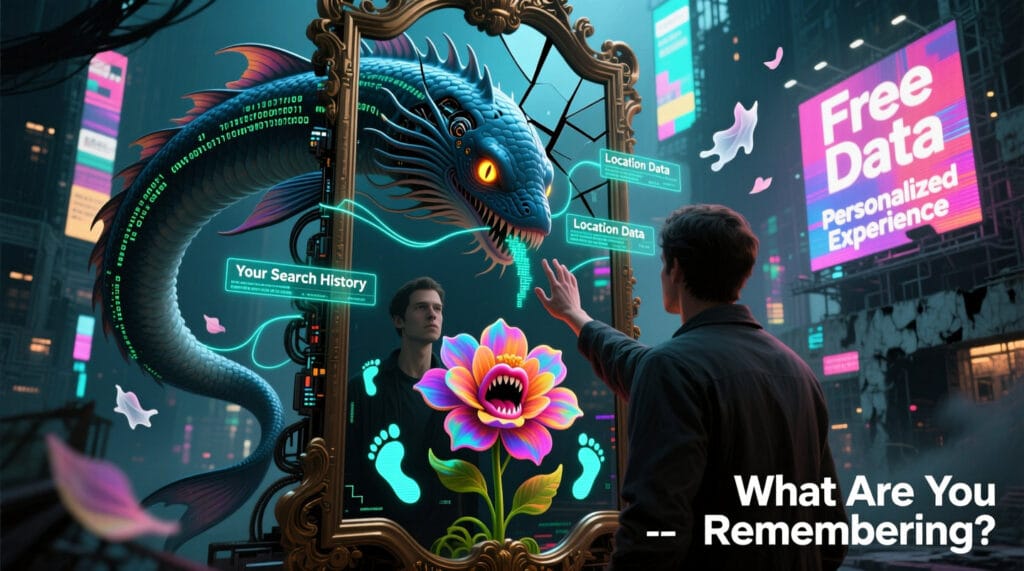
The MSA is the starting gun. The ecosystem that follows—Google’s search history, Amazon’s consumption data, and Meta’s social graph—are interconnected limbs of the same data behemoth. When unified through a single digital ID, they create an omnipotent panopticon.
As we’ve explored in the world of vehicle tracking, the push for ubiquitous data capture is the same across platforms, whether it's your car or your computer. The fight for control in the OS mirrors the control in the network, creating a data broker economy. (Short story: The 5G Data Broker Economy: How Your Network Became the Panopticon's Eyes)
The Corner of Perpetual Light (short story)
The 5G Data Broker Economy: How Your Network Became the Panopticon's Eyes
The rain in Neo-LA always fell the color of oily neon, a perfect curtain to hide behind. Kaito kept his comm-rig powered down, routing all gig-work through a patched-up burner phone he called his "Deckard." He needed anonymity; his movements were his only leverage against the algorithms. Tonight, he pulled his synth-leather coat tight and ducked into a derelict food stall on Level 3—a place so old, it didn't even accept chips, only scrip. He ordered a bowl of steaming, unadvertised yakisoba and sat in the dark.
He took one bite. It was perfect.
Just then, the burner phone, meant only for critical pings, flared with an intrusive, full-screen AR ad—not from the platform he was logged into, but from his network provider's white-labeled Data-Aggregator-34 partner. The holographic text pulsed over his ramen:
"Experiencing the Authentic Umami of Level 3? Data Broker 'Tyrell' knows your current location and is optimizing your next purchase. Special offer on Aged Scrip-Wallet Insurance—10% off for verified Level 3 customers."
Kaito froze. He hadn't searched for the stall. He hadn't checked in. The only data point was the low-level, high-band 5G trace confirming his stationary presence at that precise grid coordinate for a single minute. The network itself, silent and pervasive, had tagged him, triangulated his intent, and sold the real-time moment of his first bite.
He looked up at the grime-streaked ceiling, knowing the surveillance wasn't a camera in the gloom, but a silent, corporate eye sewn directly into the infrastructure. The Panopticon wasn't a guard tower anymore; it was the invisible, ubiquitous air of the 5G Data Broker Economy.
Kaito pushed the perfect ramen away. “You can’t quit the field, Kaito. You just wish you could.” The line from the old, banned vid flickered in his head. There were no off-world colonies left, only endless, monetized corners of the City.
Your "score" isn't displayed on a government screen; it is calculated in real-time by algorithms that determine the ads you see, the credit offers you receive, the news you’re fed, and potentially, your eligibility for digital services altogether. This creation of a mass surveillance infrastructure risks normalising surveillance in everyday life, chilling free expression through function creep.
The Deckard Option—Escaping to the Off-World Colonies
The user who recommends moving to an open-source OS like Linux is the modern-day Deckard, trying to escape the City's oppressive grasp. Linux represents the off-grid, the unmonitored, the machine that still answers only to you. It is the ultimate loophole, a statement of digital sovereignty in a world obsessed with consensus and control.
The Terminal on the Edge of the System
Decentralized Sovereignty: The Linux Escape Hatch for Digital Identity
Elara lived in the shadow of the Corporate Tower, but her true home was a dark-mode terminal screen running an operating system named 'Mint.'
For decades, the System—Windows, Mac, Google’s omnipresent cloud—had been a beautifully furnished prison. Every click was logged, every file scanned, every user treated as a marketable profile. When Elara's bank, integrated with her Microsoft Digital ID, flagged a "suspicious" purchase (a vintage piece of un-monitored radio equipment), her entire digital life, her work, her communications, were locked with a single, bureaucratic keystroke. She was locked out of her own existence.
Desperate, she salvaged a decommissioned Tyrell Corp-era laptop. The screen was cracked, the fan whined like a dying replicant, but it had a clear BIOS. Following ancient, decentralized instructions, she installed a lean, open-source OS—a machine that demanded no allegiance, asked for no cloud account, and logged nothing. She felt a profound, almost dizzying sense of digital anonymity.
Her primary machine was still a brick, a monument to corporate control, but her old laptop became her sanctuary. It didn't ask who she was; it only asked what she wanted to compute. Her personal files, her encrypted work, her true identity—her decentralized sovereignty—lived not in the ethereal cloud ledger of the Tyrell Corp, but on a cold, local drive, answering only to a passphrase she owned.
She typed a command into the terminal—a string of code that wasn't monitored, sold, or scored. It was a single-user, single-task moment of perfect, unmarketable freedom. She smiled, feeling like a pioneer who had slipped out of the City’s neon glow and into the true wild.
“The individual is a product of the collective. No one escapes,” was the old corporate dogma. Elara looked at her terminal, then back at the blinking, networked cityscape. Not entirely true, she thought. You just have to build your own system. The Linux desktop was not a product; it was a promise.
The corporate strategy relies on inertia, betting that the friction of leaving will be too great for most. The drive for a unified digital ID is an attempt to reduce the messy, anonymous, and free aspects of human existence into a clean, quantifiable, and controllable data stream.
Recommended Linux Distros for the Common Pleb (Windows & Mac Converts)
If the corporate tether has grown too tight, the open-source community offers several alternatives designed specifically for those accustomed to a simple Windows or macOS desktop. These are stable, user-friendly off-world colonies that respect your local account and your privacy:
- Linux Mint (Cinnamon Desktop):
- Best for: Die-hard Windows users.
- Why: Its interface is the most familiar, featuring a classic Start Menu and taskbar layout. It is incredibly stable and beginner-friendly, requiring virtually zero terminal commands for standard use.
- Zorin OS:
- Best for: Users seeking a modern, polished look and easy transition.
- Why: It includes a "Zorin Appearance" tool that allows the desktop to mimic the look and feel of Windows or macOS exactly, reducing the learning curve to almost nothing.
- Pop!_OS:
- Best for: Power-users and former Mac users who enjoy a clean workflow.
- Why: A modern, beautiful, and highly stable OS built by computer manufacturer System76. It’s excellent for developers, but its intuitive tiling window manager makes for a clean, distraction-free desktop environment easily adopted by Mac converts.
The future is not yet written. The dystopia is not inevitable. But the choice to fight for the right to a local account, to demand the right to anonymity, is a fight for the soul of the individual in the 21st century.
“I've seen things you people wouldn't believe.” – Roy Batty
If we do not resist this final lock-in, the things we will see—the total loss of privacy, the end of anonymity, the erosion of the right to our own digital existence—will be things future generations will struggle to believe we ever allowed to happen. The time to decide if you are a user or a product, a citizen or a data point, is now.