
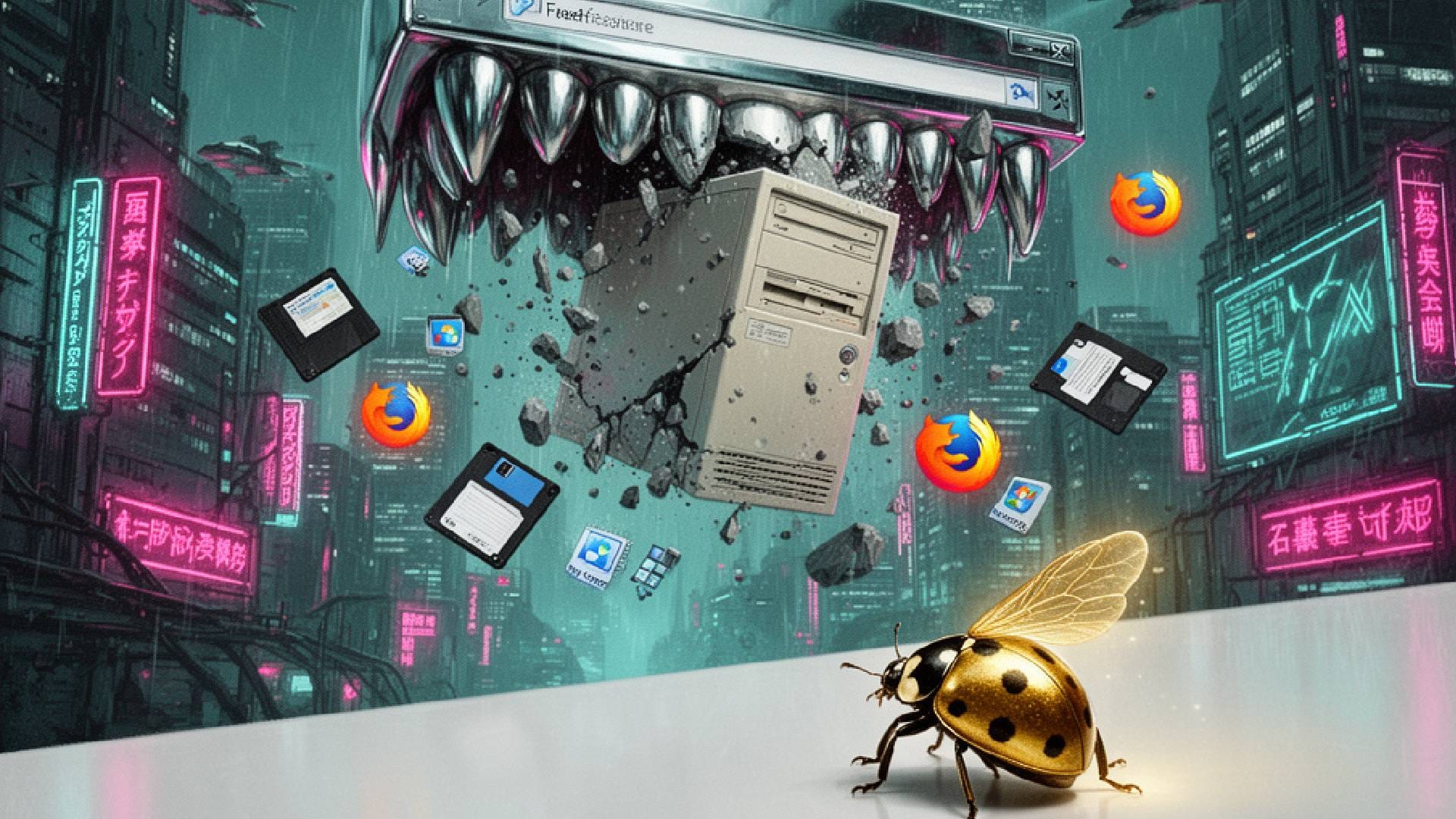
In the beginning, browsers were simple. They showed you text, maybe an image if you were lucky, and occasionally crashed so hard they took Windows 95 down with them. Today, the browser is no longer an application. It is the operating system — and in many cases, it’s a better one than the one Microsoft or Apple shipped with your laptop.
How the Humble Web Browser Became the Most Powerful Operating System on Earth
Welcome to the strange, hilarious, and slightly terrifying story of the browser that ate the OS.
Once upon a time, in a galaxy not so far away, there was a humble web browser named Surfie. Surfie was just your average browser, happily surfing the web, minding its own business. Little did Surfie know, it had big dreams of becoming the most powerful operating system on Earth!
One day, Surfie got a taste of power when it accidentally downloaded a supercharged extension called "MegaOS." Suddenly, Surfie found itself transforming into a full-fledged operating system, complete with a start menu, taskbar, and even a cute little recycle bin.
to be continued ..
From Humble Beginnings to Quiet Domination
Let’s travel back to 1994. Netscape Navigator arrives like a digital messiah, promising to “democratize the internet.” Its engineers were so optimistic they added a now-infamous Easter egg: a hidden game of Doom that ran inside the browser. Yes, in 1994 people were already trying to run full 3D games in what was essentially a fancy document viewer.
Fast-forward a few chaotic years. Microsoft tries to kill Netscape with Internet Explorer, bundling it so aggressively with Windows that the U.S. government sues them for antitrust violations. The result? Netscape open-sources its code in 1998, birthing Mozilla and eventually Firefox. Meanwhile, Google looks at Apple’s WebKit, forks it in 2008, and creates Chromium — the quiet beast that would eventually devour almost everything.
The punchline? The browser that started as a window into the computer slowly became the computer itself.
What Does It Mean for a Browser to Be an Operating System?
At a software level, a modern browser now performs nearly every function once reserved for traditional OS kernels:
- It manages processes (each tab is sandboxed like its own virtual machine).
- It handles memory, storage (IndexedDB, Origin Private File System), and networking (WebTransport, QUIC, WebRTC).
- It talks directly to hardware through WebUSB, WebGPU, WebBluetooth, and sensors.
- It runs full applications via Progressive Web Apps (PWAs) and WebAssembly (WASM), which can now rival native code performance.
When this software layer is paired with hardware hardening, the transformation becomes complete. Enter Google’s ChromeOS — a Linux kernel stripped down to almost nothing, with Chromium as the entire user interface and application runtime. Your “laptop” is now just a thin client. All your files, apps, and identity live in the cloud. The local device is essentially a stateless terminal running a browser.
This is not science fiction. Chromebooks outsell macOS laptops in the education sector. Entire companies now deploy fleets of cloud terminals where the only OS that matters is the browser.
As Surfie's power grew, it started to overshadow the traditional operating systems like Windows, macOS, and Linux. People couldn't believe their eyes as Surfie began running everything from spreadsheets to video games with lightning speed and a quirky sense of humor.
The other operating systems tried to fight back, but Surfie was just too quick, too slick, and too darn charming. It even had a built-in feature that made error messages sound like compliments! Who wouldn't want an OS that tells you "Oops, looks like you're too fabulous for this program to handle"?
Still scrolling?
The Humor in Our Surrender
There’s something darkly funny about this. In the 1990s, we mocked Microsoft for trying to make Internet Explorer the center of computing (“Welcome to the Internet Platform”). Twenty-five years later, we happily handed that crown to Google — and thanked them for automatic updates.
Even better: the privacy-conscious crowd fled Chrome only to land in Firefox… which itself now ships increasing amounts of telemetry and AI features. The cycle repeats. Meanwhile, indie heroes like Floorp, LibreWolf, and Zen Browser try to claw back user control on top of the same Mozilla codebase.
We didn’t just lose the OS wars. We turned the winner into a privacy battlefield.
And so, the once-humble web browser became the reigning champion of the tech world, proving that you don't need a fancy name like Windows or macOS to rule the digital universe. All you need is a little bit of magic, a whole lot of sass, and a whole bunch of tabs open at once!
A Glimmer of Hope: The Ladybird Browser
While the Chromium–Gecko duopoly seems unbreakable, a bold new contender has emerged. Ladybird, an independent browser engine started by former SerenityOS developer Andreas Kling, is being built entirely from scratch with zero reliance on Chromium or Firefox code.
In 2024, Ladybird received a major $200,000 grant from FUTO (the fund founded by former YouTube CTO J. Andrew “Boz” Roberts). The project’s clear motto is:
We will not be Chromium. We will not be Firefox. We will be Ladybird.
This independent spirit represents the first serious attempt in over a decade to break the two-engine monopoly. If successful, Ladybird could become the true “third path” — a clean, modern, and privacy-respecting browser that refuses to feed user data into the surveillance economy or AI training pipelines.
Its existence proves that the story of the browser is far from over.
Why This Matters Now
As browsers absorb AI agents, on-device neural processors, and autonomous workflows, the stakes rise dramatically. The browser is no longer just where you watch cat videos. It is becoming the orchestration layer for your digital life — deciding what you see, what you do, and what data gets sent to cloud AI models.
The browser ate the OS. The question is whether we’re comfortable with what it’s becoming next.
References
- “The Browser as Operating System” – IEEE Internet Computing, Vol. 23, Issue 4, 2019. https://ieeexplore.ieee.org/document/8761234
- “Chrome OS: Cloud-centric Operating System” – USENIX ;login, 2010.
- “When the Browser Becomes the Operating System” – IEEE Spectrum, March 2022. https://spectrum.ieee.org/browser-operating-system
- “A History of the Web Browser” – CERN Technical Report, Tim Berners-Lee archives, 2021.
- “Site Isolation for Spectre and Meltdown Defense” – Google Security Blog & USENIX Security Symposium, 2018.
- “The Chromium Project: Architecture and Security Model” – Google Whitepaper, 2024. https://chromium.org
- “Netscape and the Browser Wars” – Communications of the ACM, Vol. 42, No. 4, 1999.
- “The Case for Browser-based Operating Systems” – HotOS XIII, ACM, 2011.

SPACELAUNCH NOW!
Get Your Site Up & Running
SpaceLaunch is an ideal choice for those seeking to swiftly establish their own website, it offers a comprehensive and user-friendly solution backed by essential features, FREE domain registration / transfer / renewal, 1h FREE technical support to get you going, and the flexibility to grow and expand as needed (add-ons available).